Luck and Fate in Gambling
Casino RoyaleLuck in gambling is presented as an uncertain force that can be studied in its conditions but never controlled. James Bond’s approach combines mathematical attention, intuition, ritual, and personal accountability: chance may shape the result, but a player must distinguish bad fortune from bad decisions. The baccarat contest with Le Chiffre gives that creed its hardest test, as Bond’s calculated commitment brings him close to losing everything before an unexpected financial rescue lets him continue.
Bond’s Gambling Creed
Bond’s attraction to gambling begins with its atmosphere and its structure. He enjoys the cards’ dry riffle, the measured drama around the green tables, the comfort of the card room, and the quiet service beside the players. He is drawn both to watching other people make decisions and to the moment when he must make one himself, often with the outcome balanced on an apparently even chance. Gambling offers participation in other people’s dramas, but it also places the player’s own judgment under pressure.
Its strongest appeal, for Bond, is responsibility. At the table, he believes, there is only oneself to praise or blame. Luck may be accepted with a shrug or used to the fullest, but it must not be confused with a poor estimate of the odds: the fatal mistake is calling bad play bad luck. That distinction makes his attitude less a faith in winning than a discipline for interpreting loss. He imagines luck as something to court or take advantage of, never to flatter or pursue blindly, and recognizes that neither luck nor love can always be kept at a safe distance. The endpoint of that recognition is fallibility: the gambler may eventually be brought to his knees and forced to acknowledge that control has limits.
Ritual, Calculation, and Intuition
Bond’s play at roulette shows how he tries to live by the distinction between chance and judgment. After returning to the Casino, he studies the recorded sequence of the ball, although he knows that each spin is independent of the one before it. He observes the croupier’s practiced movements—the wheel turned one way, the ivory ball sent the other—and understands that the apparatus and procedure are designed to prevent either the croupier’s skill or a wheel’s bias from determining the result.
The contradiction does not make him abandon the record of previous spins. Roulette players, by convention, attend to unusual runs; Bond follows that custom, noting extended repetitions and sequences in the outside chances. He does not defend the practice as proof that the past dictates the next result. Instead, he maintains that effort and ingenuity are part of what a gambler brings to the game. His method therefore inhabits a tension: intellectually, he accepts that every spin begins afresh; practically, he looks for patterns that may guide a wager.
On this June evening, Bond converts one million francs into plaques and bets the first two dozens, placing the maximum of one hundred thousand francs on each. The wager covers two-thirds of the numbered board, apart from zero, and yields a hundred thousand francs whenever a number below twenty-five appears. He wins six of the first seven throws, loses when thirty comes up, then sits out the next throw, when zero appears. Treating thirty as a sign to change direction, he switches to the first and last dozens. After the middle dozen appears twice and costs him four hundred thousand francs, he leaves the table one million francs ahead. The gain is real, but the sequence does not establish that his reading of the wheel caused it; it dramatizes the persistent gap between a gambler’s interpretation and the independence of chance.
Baccarat as a Contest of Information and Capital
Before the baccarat game, Bond explains that the odds between banker and player are nearly even, but that a run in either direction can decide whether the bank breaks or the players do. Le Chiffre has bought the bank from the Egyptian syndicate running the high tables for one million francs, leaving him with twenty-four million in capital. Bond has about the same amount. His stated objective is not simply to take a share of the game: he intends to accept the bank’s wagers whenever possible and continue until either he breaks Le Chiffre’s bank or Le Chiffre breaks him.
The rules make this a contest of both money and information. At Royale, the lack of enough baccarat players means Le Chiffre will face a single tableau rather than divide the game between two sides. The banker has a slight advantage, and controls the size of the wagers; Bond hopes, in turn, that his direct attack will unsettle Le Chiffre, who does not know Bond’s capital. The six-pack shoe is shuffled and cut in view of the table, and Bond says the staff have been checked. These precautions establish a game whose suspense is not based on a secret device, but on the sequence of decisions, the players’ resources, and what each can infer about the other.
Bond’s explanation of the cards makes the informational imbalance precise. A total of eight or nine is a natural and wins unless the banker has an equal or better natural. With a weaker hand, the player chooses whether to draw or stand, while the banker must wait to see that choice before deciding how to play. A stand suggests a hand of five, six, or seven; a draw indicates a lower starting total, though the face-up third card may improve it. The banker thus gains a small advantage from seeing the player’s action, while both sides must confront the uncertain decision of whether to draw on five. Bond says that he follows intuition on that question, but concludes that the natural eights and nines will matter most. Calculation narrows the field of uncertainty; it does not remove it.
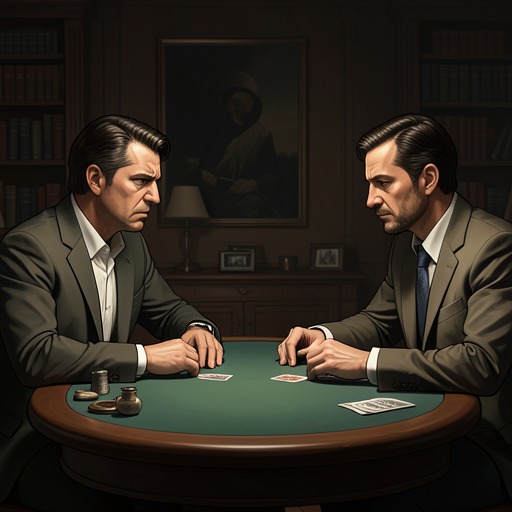
The contest is also staged as a public ritual. Bond takes his twenty-four million francs from the cashier, divides the notes into equal packets, and puts one half in each coat pocket before approaching the baccarat table. Le Chiffre enters through the opening in the brass rail and takes the banker’s chair opposite him. The cards are placed in the shoe; the banker announces the opening stake; players accept or pass; and the croupier calls each bank. The short declarations, repeated wagers, and careful dealing turn private decisions into a shared spectacle. As the game continues, Bond settles into his chair for the long sequence, while the table’s procedures give each changing fortune a visible, publicly acknowledged form.
Ruin, Reprieve, and the Limits of Mastery
The decisive test comes when Bond’s calculations and nerve cannot guarantee that he will remain in the game. After losing twelve million francs in two coups, he has only sixteen million left, exactly the amount of the next bank. His confidence gives way to acute awareness of how rapidly his capital has disappeared. Le Chiffre’s tapping at the table and his steady attention make the wager feel like a direct challenge, but Bond’s choice is still expressed through the game’s formal response: he follows the bank and puts forward his remaining notes and plaques without signaling that this is his last stake.
The anonymous envelope changes the immediate position, not the underlying uncertainty. Bond opens it below the table and finds thirty-two million francs, accompanied by a note identifying the money as American Marshall Aid and extending the compliments of the United States. The sum gives him a reprieve after his apparent defeat, but he does not mistake it for a victory or for a guarantee of what comes next. He knows that he must still win, and that Le Chiffre may already have accumulated the fifty million francs he needs.
Bond uses the new stake strategically. He reasons that Le Chiffre requires another eight million francs and will not want the whole thirty-two-million-franc bank covered. If Bond accepts the entire wager, he expects to jolt Le Chiffre, who cannot know that the envelope has restored Bond’s resources. Bond’s analysis is confirmed when Le Chiffre needs only eight million more. Yet the renewed wager does not end chance’s hold over the scene: Bond decides to follow, grips the table’s edge, and waits as the stake is organized and the play approaches its announcement. The money that rescued him also magnifies the risk, making the next decision another commitment rather than a settled outcome.
Meaning and Narrative Function
The novel’s treatment of gambling distinguishes calculated play from the fantasy of command. Bond observes procedures, studies records, estimates odds, and reads opponents, but the roulette spins remain independent and the baccarat hand can still overturn a player’s expectations. His insistence on personal responsibility supplies an ethical discipline for chance: a loss should not automatically be excused as misfortune, just as a gain does not prove that one has mastered luck.
At the baccarat table, the game’s procedures turn that discipline into visible action. Capital is counted, wagers are announced, cards are dealt in full view, and the crowd gathers when thirty-two million francs are at stake. The ritual gives uncertainty a public shape: a decision that began as private calculation becomes a spectacle in which others can witness the risk and its consequences. The repeated gestures and calls sustain suspense without making the outcome predictable.
Luck, finally, is neither Bond’s master nor a dependable servant. His changing fortunes—including a roulette profit, the rapid loss of twelve million francs, and the envelope that restores his capacity to wager—show how outcomes can reverse while the gambler’s obligations remain. He must continue to judge, choose, and accept the consequences, but cannot convert judgment into certainty. That unresolved balance between competence and vulnerability is what makes gambling, for Bond, both an absorbing drama and a test of fallibility.